

Is no-code the future of industrial supervision?
The Rise of No-Code Platforms
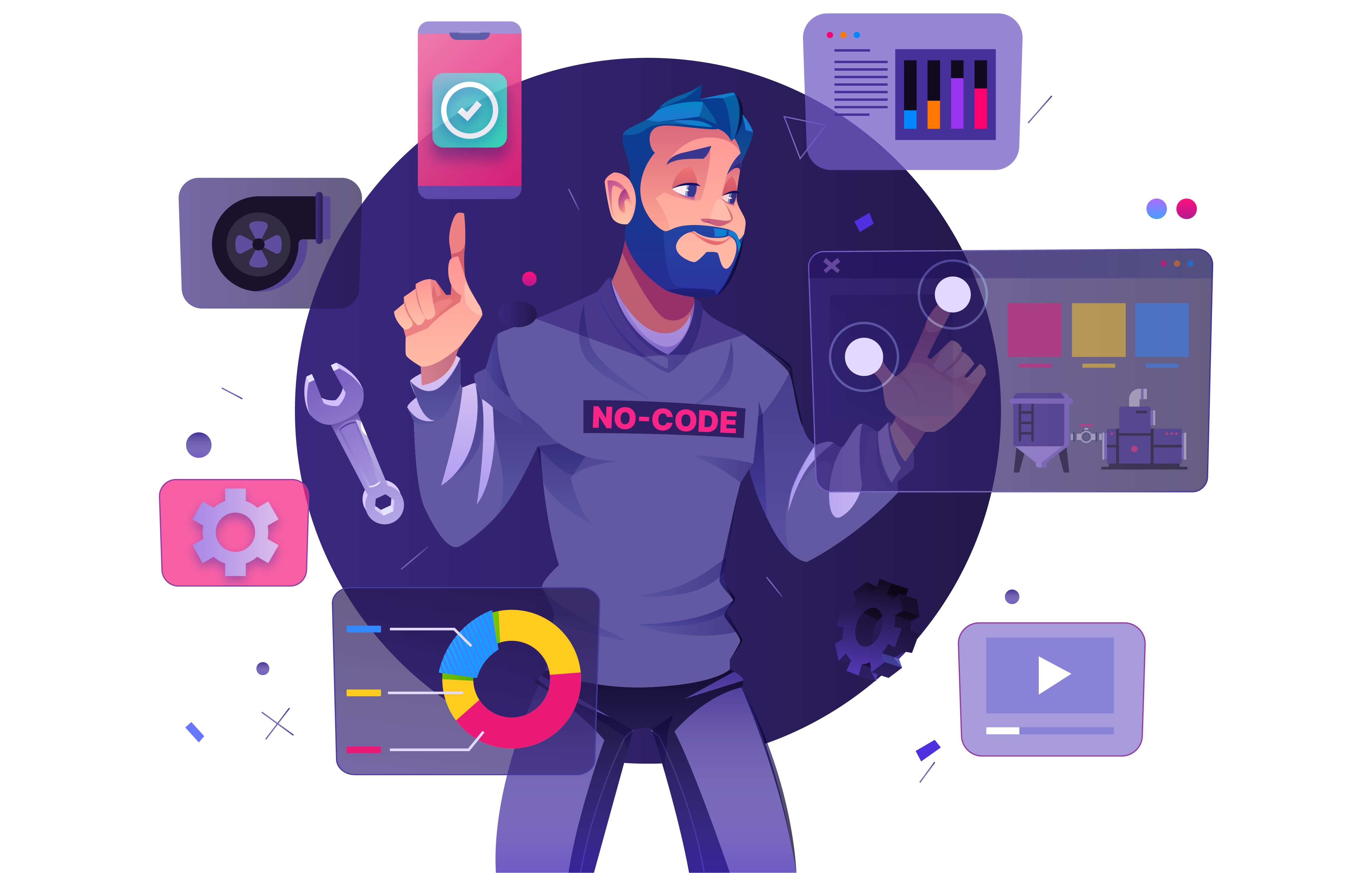
What if it were possible to build websites, mobile applications, and even complex industrial supervision applications without writing a single line of code?
This is the premise embraced by a growing number of startups championing a movement called 'no-code'. No-code generally offers visual drag-and-drop development, eliminating the need to write a single line of code. It primarily targets professionals who don't know any programming languages but want to develop an application for a specific use case. 'Low-code' is a complementary concept that allows editing an application's source code without having to develop it from scratch. Key players in this sector include platforms such as Webflow, Bubble.io, or Adalo.
The rise of no-code is the industry's response to the combination of two factors:
- the growing need for all kinds of applications (due to the omnipresence of smartphones and connected objects in our lives)
- the strained developer market.
Application development is expensive, and the industry is looking for solutions to reduce costs. Following the offshoring of development teams, the no-code era allows, at a minimum, for prototyping applications without requiring developer intervention.
According to Gartner / Forrester, the low-code market is projected to reach $53 billion by 2024. Similarly, a MarketsAndMarkets study forecasts growth for these platforms from $13.2M in 2020 to $45M in 2025.
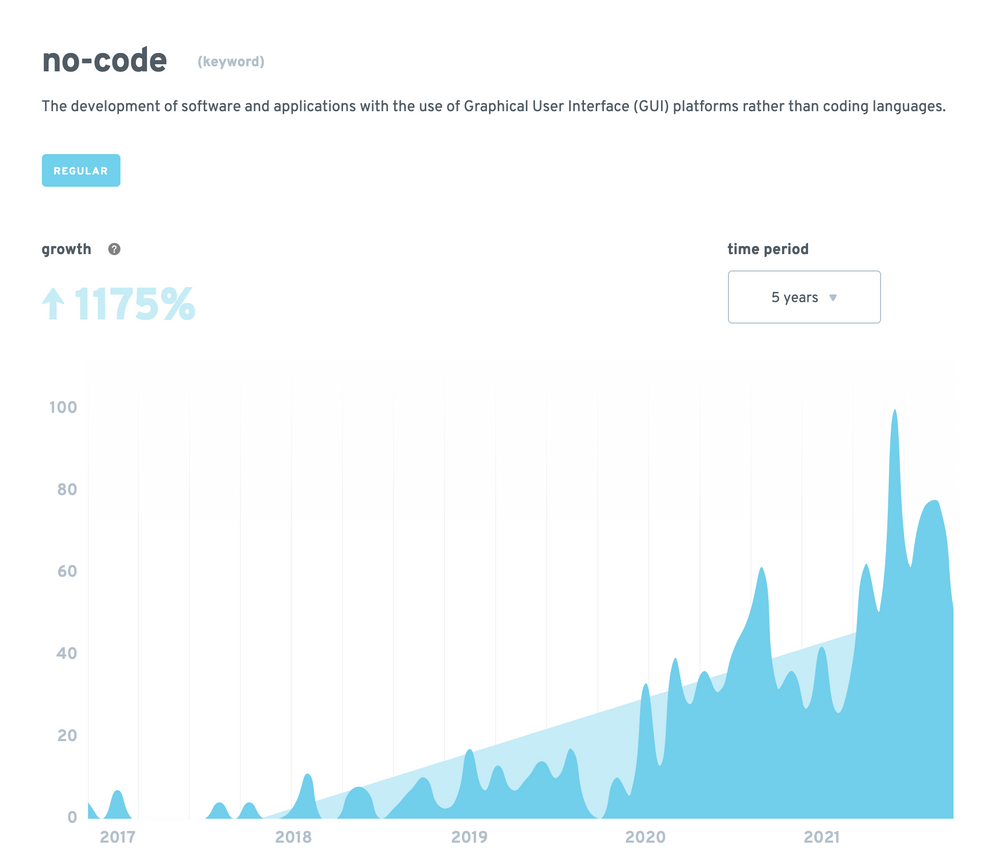
Given the market's importance and growth, the sector faces intense competition from tech giants. Microsoft's low-code development service, Power Apps, is its fastest-growing product. It could eventually generate over $10 billion in revenue for the company. Google recently acquired AppSheet, a low-code/no-code editor that allows users to create business applications from Excel spreadsheets.
It's worth noting some open-source initiatives aimed at making this technology accessible to the widest audience: Go-lowcode and OpenLowcode are two open-source platforms designed to democratize low-code.
Furthermore, the goal of low-code is not to replace traditional development, but rather to free developers from simple and tedious tasks so they can focus on higher-value tasks and the programming of complex applications.
Industrial supervision, a potential low-code customer?
Currently, implementing an industrial supervision tool requires an integration phase to adapt it to the end customer's needs. Supervision software packages are mostly installed "on-premise," and their integration requires three distinct tasks:
- Developing the application to meet business needs.
- Installing and configuring the hardware infrastructure.
- Installation and commissioning of the application on-site.
These various tasks are generally carried out by a specialized system integrator or directly by the end customer if they have in-house expertise.
Before starting to code an application, in addition to purchasing a specific development license, the integrator must undergo paid training on the chosen software package. Based on our experience, the cost of this step is significant, and the learning curve for these software packages is relatively long. They will then need to configure the tool, connect to field data, and create interfaces to meet business needs.
To cover any needs, market software packages allow developers to add their own code, most often in the form of "routines" (particularly in Visual Basic, as supervision software is most often exclusively available on Microsoft platforms). This is both a strength and a weakness: customization becomes infinite, but the software's complexity grows in parallel with the technical skills required for its configuration and maintenance. Paradoxically, although current tools offer extensive customization possibilities, some features that are obvious in 2022 are natively absent, such as HTML5 or responsive design.
Alongside these implementation difficulties, the market for developers in industrial IT is also very tight, perhaps even more so than the market for "traditional" developers. Indeed, in a world that highlights the success stories of unicorns and GAFAM companies, young developers unfortunately have less interest in industry and the technologies integrated into current software packages (VB). Industrial supervision must reinvent itself to attract young talent again!
SCorp-io, the first no-code platform for industrial supervision
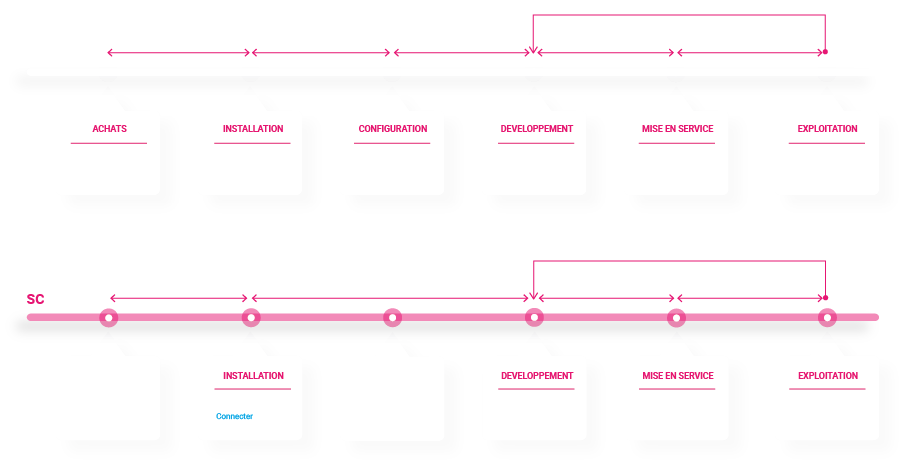
SCorp-io is a SaaS platform that allows developers to eliminate hardware infrastructure installation and configuration tasks, as well as on-site application commissioning.
SCorp-io's goal is to provide industrial application developers with the necessary tools to quickly build an industrial supervision application. SCorp-io facilitates the creation of the application foundation (object models, instantiations, linking with field data, layout, etc.) and allows developers to dedicate more time to high-value tasks such as creating interfaces perfectly adapted to the end-user.

Key features streamline the development phase
- abstracting the complexity of field data acquisition
- configuring your own equipment library by creating object models
- an integrated graphical editor for designing synoptic displays
- a versioning system that allows modifying the supervision application without affecting its operation
- complete application customization, including a layout tailored to the end-user's needs and brand
- a natively responsive, full HTML5 application
Conclusion
“No-code adoption is happening at lightning speed. But will it kill programming? No, the two coexist and will continue to do so.” Erwan Kezzar, CEO of Contournement
Indeed, low-code/no-code and traditional development are complementary. The SCorp-io team has strong development skills, yet this showcase website was built with a no-code application! Using a no-code tool allowed us to dedicate more time to developing our SCorp-io cloud platform.
We share this vision. With SCorp-io, we aim to simplify the work of industrial supervision developers by providing the right no-code tools, enabling them to dedicate more time to customizing their applications.
If you are interested in testing SCorp-io, you can sign up here for our early adopter program!
You might be interested in this
Explore more articles on energy management and smart buildings.

Ready to transform your energy management
Start with a personalized demo or a free audit of your facilities.
