Melun manages 53 buildings, funded by CEE
How the city of Melun centralized the supervision of 53 public buildings and saved €900,000 in the first year with a cloud-based BMS funded by energy savings certificates: BACS and tertiary sector compliance, multi-site management.



The context: a substantial public property portfolio, limited teams
Like many French local authorities, the city of Melun manages a substantial real estate portfolio: town halls, schools, gymnasiums, sports facilities, and administrative buildings. There are dozens of sites, each with its own equipment, protocols, and installation history. Some buildings date back to the 70s, others are recent; some communicate via Modbus, others via KNX, and some not at all.
Faced with rising energy costs and looming regulatory deadlines, the city needed to modernize its property management in depth. But with limited technical teams and a fragmented portfolio, control remained rudimentary: manual on-site interventions, a lack of overall visibility, and constantly rising operational costs.
The challenges: managing, complying, and financing
The city faced three structural challenges.
- A property portfolio that is difficult to manage remotely. With dozens of equipped buildings, every adjustment required a physical trip. A radiator heating an empty gymnasium on a Sunday, a school boiler running during school holidays: no one could see it, let alone prevent it. Technical teams spent their time managing emergencies rather than anticipating them, resulting in high operational costs and no consolidated view of consumption across the portfolio.
- Regulatory obligations to meet. The Tertiary Decree requires a 40% reduction in consumption by 2030 for buildings over 1,000 m², with an annual declaration on the OPERAT platform. The BACS decree requires an automation and control system for commercial buildings. Without centralized supervision, it is impossible to measure efforts, document them, or prove compliance in the event of an audit.
- A project to be financed intelligently. A local authority uses public funds: there is no question of investing heavily without a guarantee of results. A solution was needed that minimized out-of-pocket expenses while ensuring a rapid and demonstrable return on investment for the city council.
The solution: a multi-site cloud BMS, without major construction
SCORP-IO deployed its BMS platform across the entire Melun portfolio, without replacing equipment or performing major construction. The architecture is based on a simple principle: in each building, a Connecter module (an edge device installed on-site) connects to existing equipment via standardized building protocols, BACnet/IP, KNX, and Modbus. Data is sent to the cloud platform, and teams access a unified dashboard to supervise, analyze, and manage the entire portfolio from a single interface.
This multi-protocol approach is decisive for a local authority: it allows buildings of different eras and technologies to be integrated into the same supervision system, without imposing a specific equipment brand or starting from scratch at each site.
From reaction to anticipation: what changes for the teams
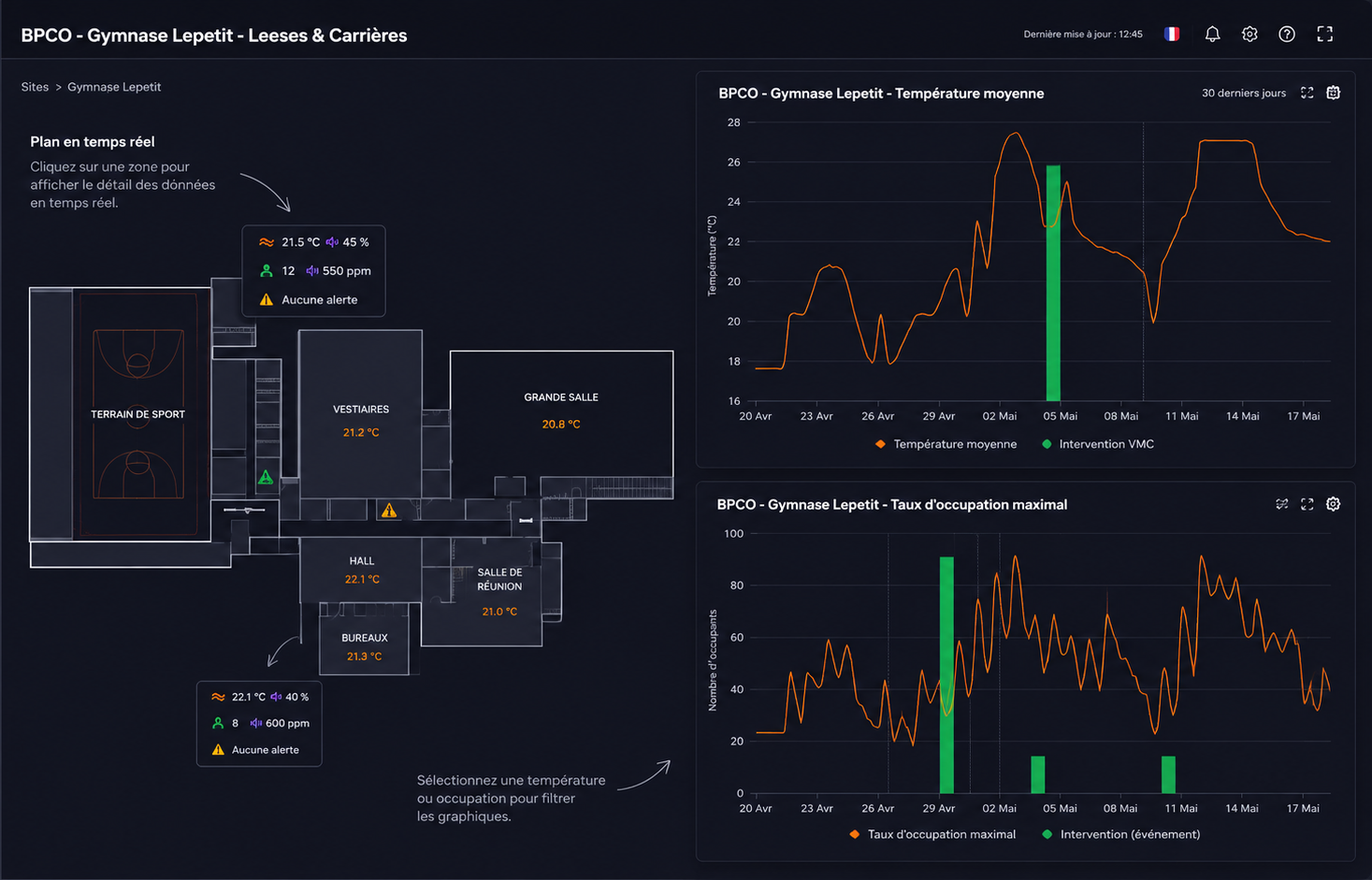
The city's technical teams now have centralized supervision of all their sites, accessible on the go. With automatic alerts for deviations, customized dashboards per building, and consumption analysis by zone and equipment, reactive management has given way to proactive management.
The change is as much organizational as it is technical. Rather than running from one site to another for manual adjustments, teams focus their time on analysis and optimization. A consumption deviation detected on Monday morning from the interface avoids a trip, a surprise bill at the end of the month, and sometimes a costly breakdown a few weeks later.
Regulatory compliance, documented and auditable
In terms of regulations, the platform ensures compliance with the BACS decree and provides a Class A BMS (NF EN ISO 52120-1 standard), exceeding the minimum requirements of the decree. Consumption data is collected automatically, traceable, and exportable for the Tertiary Decree's OPERAT declarations.
Melun has thus moved from a state of non-compliance to documented and auditable compliance. For a local authority, this goes beyond a simple obligation: it is also a matter of setting an example for citizens and a prerequisite for certain types of public funding.
Funding: A project supported by Energy Savings Certificates (CEE)
This is often the main hurdle for local authorities, and this is where Melun’s case becomes a model. The project was fully funded through Energy Savings Certificates (CEE), thanks to the involvement of SOBREN, a partner specializing in managing these applications. Building Management Systems (BMS) specifically fall under the CEE BAT-TH-116 sheet, which incentivizes their installation in commercial buildings.
Result: The city deployed a BMS across its entire property portfolio while minimizing its initial investment. This funding model can be replicated by any local authority, regardless of size, as long as the CEE scheme supports this type of operation.
Results
Beyond regulatory compliance, the very way the property portfolio is managed has changed. Technical teams can now view all buildings in real time from a single interface: consumption drifts are identified in minutes rather than being discovered on the bill, on-site visits are limited to necessary interventions, and systems operate as closely as possible to actual needs.
Financially, the savings generated from the very first year prove one thing: energy management across a property portfolio can produce concrete results without heavy investment, provided the project is supported by Energy Savings Certificates. And because supervision, automation, and monitoring run continuously, these performance levels are not just a one-off success—they are sustainable over the long term.
The project's key indicators are summarized below.
"SCORP-IO has transformed our multi-site energy management. Compliance ensured, costs controlled, teams freed up."
Alexis Gelenne, Utilities Manager — City of Melun
What this project demonstrates
The Melun case proves that a local authority can transform its property management on a large scale: 53 buildings, multiple protocols, small teams, and no heavy construction or equipment replacement. The combination of a cloud-based BMS and CEE funding makes the project accessible and profitable from the first year.
It is a model for all local authorities that want to anticipate the deadlines of the BACS and Tertiary decrees rather than just reacting to them: documented compliance, measurable savings, and technical teams finally regaining control over their property portfolio.
FAQ: BMS for local authorities
You might also be interested in
Discover other client case studies on energy management and smart buildings.