

Why is SaaS becoming indispensable in the industrial landscape?
What is SaaS software?
A SaaS (Software as a Service) application is a computer program hosted in the Cloud, making it accessible anywhere, anytime, from any connected device. Gone are software licenses, infrastructure, and maintenance costs; the application is managed remotely by a specialized provider. In addition to lower operating costs, this type of software offers numerous benefits, which we will detail later.
The SaaS industry is valued at approximately 145 billion. Since 2015, the SaaS industry has grown from 31.5 billion to 145.5 billion in 2021. The market valuation has increased fivefold in 6 years. The SaaS industry is expected to experience its strongest growth between 2021 and 2022, reaching 171.9 billion by the end of the year. (Source: Gartner)

Let's detail the benefits of migrating from an On-Premise software to a SaaS solution:
Reduced operating costs
Switching to SaaS can reduce operating costs by up to 30%.
- No more infrastructure costs, no need to acquire on-site hosted servers
- No more significant costs for acquiring perpetual licenses
- No more maintenance costs related to hardware or updates requiring technician visits
Of course, SaaS is not free and often operates on a subscription model, but this model allows for predictable and adapted pricing based on software usage.
Improved user experience
- Multi-user : As mentioned previously, SaaS software does not require an operating key, license, or tokens. It can be operated from a control room, as well as from a mobile device while teleworking. Be aware that some SaaS providers use this criterion to vary their subscription prices; for example, Netflix's subscription price varies depending on the number of simultaneous connections allowed.
- Multi-site : The arrival of COVID-19 accelerated the development of remote work. The ability to monitor equipment, a production line, receive real-time alerts in case of anomalies, and especially to act at any time of day—whether at home, in the field, or at a client's site—has become a major challenge in an era where even the slightest production halt can lead to significant losses for a company.
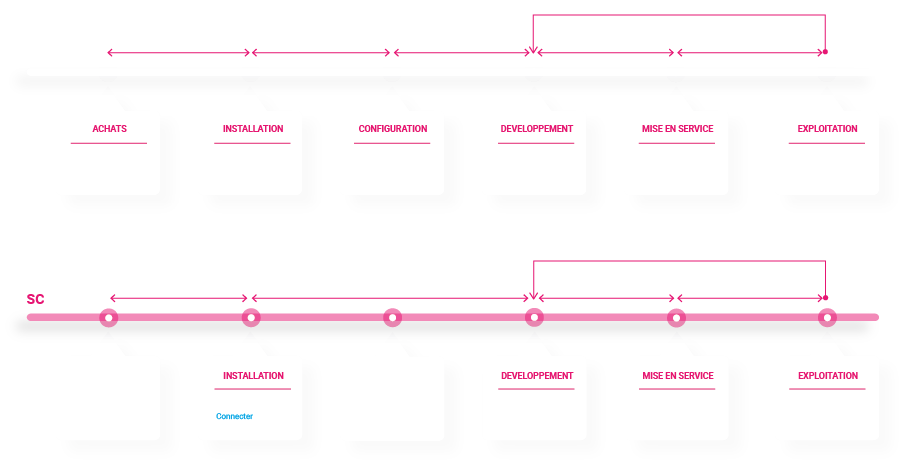
- Deployment time : Today, the time between acquiring on-premise software and the day it actually goes live can take several days/weeks (hardware acquisition and installation, technician availability, etc.). By opting for SaaS software, this delay is reduced to... just a few minutes! This allows for quicker adoption and saves both time and money.
- Flexibility : Another significant advantage concerns SaaS software updates. With SaaS, there's no longer a need to schedule interventions and operational shutdowns for a simple update. SaaS software updates are completed in minutes and are entirely transparent to all users. This allows for rapid adaptation to an industry and needs that are constantly evolving.
SCorp-io: SCada-as-a-Service
Multi-user

SCorp-io allows your teams to receive alerts and act on their equipment remotely, at any time of day, from their mobile, tablet, or computer. Each profile within your company has access to the data and events relevant to them, which significantly speeds up response and reporting times. No one needs to wait for an event behind a fixed monitoring screen anymore. Every stakeholder in the company has "their" supervision in their pocket! The right person is alerted and can intervene immediately.
Mobile or remote work? SCorp-io is accessible at all times and adapts to all screens!
Multi-site

Is your architecture complex and your sites geographically distributed? SCorp-io allows you to centralize your sites and monitor your entire infrastructure from a single application. Install our SCorp-io bridge module on your sites and upload your data to your unique project on our cloud platform. Our bridge module is ultra-lightweight and can be very easily embedded in any machine.
Time to Service & Flexibility
Conclusion
We've recognized that Industry 4.0 presents both an opportunity and, more importantly, a challenge for the industry. That's why we designed SCorp-io, aiming to combine our expertise in the SCADA world with the benefits a SaaS can offer.
We acknowledge that SaaS also has drawbacks, such as inaccessibility when internet access is unavailable. That's why we are developing a 'hybrid cloud' technology with our module Connecter which integrates features like 'store and forward,' enabling local data storage during communication outages.
If security (a topic not covered in this article) is also important to you, feel free to check out our articles on the subject.
If you're interested in testing SCorp-io, you can sign up here for our early adopter program!
You might be interested in this
Explore more articles on energy management and smart buildings.

Ready to transform your energy management
Start with a personalized demo or a free audit of your facilities.
